

Sunday, August 31, 2008

Tatana Village

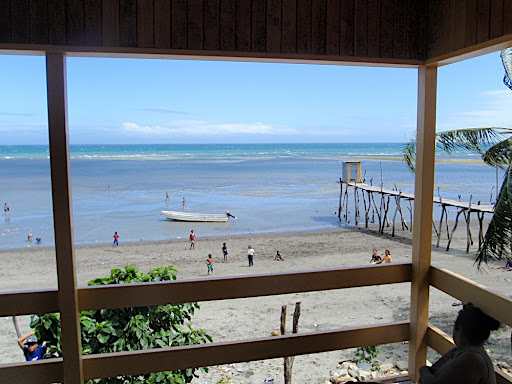
MedCAP [read: Medical Civilian Assistance Program] to Tatana, day one. Tatana is a small island community connected to mainland PNG by a small land bridge not very far from Port Moresby. It is a mountain shaped island with most all inhabitants living on the water's edge on stilted houses. Interestingly there is no fresh water is available on island as such they must trek water in, a job done solely by women, hauling 20L tanks of water to and from the water tank/well. People are very close with each other, they are forced to be close, living on a small island necessitates that. So they all talk about ecah other like gossip you might hear at lunch in high school. Children flock together and play like as if a kabbutz. It is a beautiful village with a great view. The people were exceptionally nice, many of them make what money they have by fishing.
I set up shop on a table up stairs in the church hall next to the window with a view of the water and windows that let in light and a cool sea breeze. The day went by so quickly, it seemed like I had hardly started seeing patients when the end of the line found its way inside.
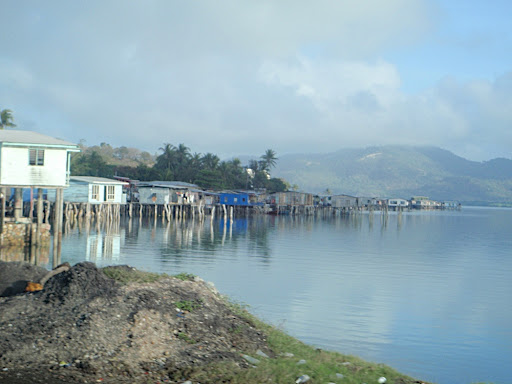
The next day I returned to Tatana, getting a warm greeting from the community just like before. Outside, next to the line of people looking for medical care is a group of people who needed no further healthcare... I say this because they were strong young men playing a very competitive game of volleyball, the likes of which would hold its own weight even on the sand courts of Mission or Huntington Beaches. This day my personal goal was to give everyone smoking and betelnut cessation advice. This is on top of the ergonomics, exercise, and stretching counseling I would give everyone I wrote NSAID treatment for. Ergonomics is a big problem here--the woment stay hunched over for long periods time doing repetative tasks such as washing clothing. They do so on the floor, sitting crossed-legged, leaning forward rubing the clothes inside a big bowl of soapy water in front of them. What you will never see is them put the bowl on a table so that the whole operation is at elbow level.
Later that night we tried betelnut with Sonia--it was her last night. Betelnut is chewed with much ritual. first you shuck the betelnut, exposing the seed which you can pack in your cheek. Next you grab a kava (member of the pepper family) seed pod and lick it, dip it in Lyme (Calcium Carbonate) and add that to your mouth's mixture. Once the chemicals combine you start looking much closer so someone with red paint in their mouth than anything else. The stuff gives you a quick buzz, lightheadedness, flushing, and increased heart rate--but most of all it causes you to perpetually spit nasty red looking stuff. I know its terrible for you. I saw people all day long who had dental and oral medical problems, even cancer, from chronic betelnut chewing. Nonetheless, we couldn't leave PNG without trying it once. (I understand the irony of this in relation to what I wrote in the previous paragraph) Needless to say, I'm quite sure that this was the last time we tried the stuff, it tasted like stink and left your mouth feeling like you just chewed on a piece of chalk.

Bon Voyage,
~Nic

Saturday, August 30, 2008

PNG: Lost in Translation

My goal for today was to see greater than half as many patients as the ER doc I was working alongside. I was really in the flow and rhythm of seeing patients, when a man with an unusual problem came to my table. He was very short-stature, probably no more than five feet, and his body was childlike while his head was normal-sized and fully-matured. In medicine we would say that he looks “syndromic” meaning that he probably had some sort of genetic or congenital disorder like Down’s or autism. If you’ve ever seen anyone with Down’s you would probably agree that they have a characteristic look. However, since there are hundreds of these syndromes and they are tough to remember, only a few physicians whoa re experts in identifying these disorders remember them all. The rest of us just say the patient looks “syndromic.”

So anyways the patient sits down and I ask him if he takes any medicines. He does not respond, at which point the translator intervenes and tells me that, “This patient is deaf and mute,” and so he cannot speak or understand me.

“OK fine” I say. Then reflexively I switch to using the translator mode. “Can you ask him what medicines he takes?” I say.

The translator then proceeds to act out my question to the patient without using sounds, as if he were playing charades. He motions about putting things in his mouth, presumably to mean taking pills. Satisfied that he was understood next he points his index finger at the patient indicating that he wants to know if the patient takes pills.

The patient nods in understanding and shakes his head “no”.

“He doesn’t take any meds,” says the translator.

--pete

Friday, August 29, 2008

On Silence

A citation from Pathologies of Power:
"Dr. Plarr was a good listener. He had been trained to
listen. Most of his middle class patients were accus-
tomed to spend at least ten minutes explaining a simple
attack of flu. It was only in the barrio of the poor that
he ever encountered suffering in silence, suffering
which had no vocabulary to explain a degree of pain,
its position or its nature. In those huts of mud or tin
where the patient often lay without covering on the dirt
floor he had to make his own interpretation from the
shiver of the skin or a nervous shift of the eyes."
Graham Green, "The Honorary Consul"

I have often found that many of the patients in the poorest situations have been difficult to communicate with because of they would not volunteer information, would not express their complaints. I never knew if they lacked communication skills or they simple did not wish to speak or complain. In the case of non-english speakers, it could have been the language barrier.

This has also been very true in this part of the world. In Papua New Guinea, one of the pharmacists remarked about how "stoic the people in this country are." People will have suffered incredible injuries or illnesses, and will not express what I would have considered "the appropriate amount of concern." One lady complaining about a headache didn't even want to mention to me her huge draining abscess-looking-thing on her index finger. I, of course, freaked out. Her response was something like, "yea, it hurts."

Initially, I thought: I guess these people would have to be stoic to put up with all the difficulties they deal with. This includes having to walk everywhere for hours at a time, the resulting knee and back pain, not having enough fresh food available, a failed social services system, the terrible terrible heat and humidity, lack of sanitation, high crime rates, etc.
However it has come to my attention that this subject has been thought about before, and I can put it no better than the eloquence of Paul Farmer (sorry it was so long its paraphrased):

You don't have to be a doctor to know that the degree of injury, of suffering, is unrelated to the volume of complaint. I have seen the sullen, quiet faces in waiting rooms in Peru, say, or in prison sickbays in Russia.
Members of any subjugated group do not expect to be received warmly even when they are sick or tired or wounded. They wouldn't expect Dr. Plarr (from above) to invite a long disquisition about their pain. They wouldn't expect the sort of courtesy extended to the priveleged.
The silence of the poor is conditioned. To describe as stoic is not to be wrong, but rather runs of the risk of missing the great eloquence beneath the silence.
~paraphrased from Pathologies of Power

I could say something here, but I will just leave this with the power of those sentences.

~ryan

Thursday, August 28, 2008

PNG Key Points

This is an excerpt from my PNG Gaire experience. I included it here because it makes several points. On my first day I saw a woman with sarcoidosis. Briefly this is a rheumatologic condition (like lupus or arthritis) that has no cure, gets worse with time, and imparts rather sever disability on those afflicted with it.

This woman was in a wheelchair. She traveled two days from a neighboring village to be seen by us. She had to be pushed along the concrete floor in our clinic so I have no idea how she made it several miles from another village.

Point 1: many patients traveled several days and/or waited in line for many hours to be seen, but not a single one of them complained.

She had her medical record with her. She had been given the correct diagnosis at Port Moresby hospital. I thought she had received the correct treatment with prednisone, but the dermatologist in our group said methotrexate was better. The dermatologist showed me the relevant physical exam findings for this disease and then she took photos of the woman. These were to show the dermatology residents she taught back in the US, most of whom would never see a live patient with this disease in their 8+ years of medical training. The dermatologist did some education for the woman about her disease, left several therapy recommendations in her medical record, and sent her on her way.

Point 2: Many of the people here had a small notebook that had their medical history in it. This aided greatly in helping to get their story right, and (I think) it sometimes helped to move their case forward because we could leave recommendations from our experts for therapies that local doctors could carry out.

So in the end we didn’t do much for this woman except to give her information about her disease and to facilitate her getting the optimal therapy for her terrible illness. She thanked us and left with a smile on her face, ready to set out on her multi-day journey home.

Point 3: The people of PNG were so grateful for whatever we could do for them. No one complained, not even once. And many of them brought gifts which they gave at the end of their encounter to their providers.

--pete

Wednesday, August 27, 2008

Koki Village, PNG

Medcap to Koki village, my first trek into PNG. What nice people they have here. Everyone is very nice, appreciative, and giving. We were greeted with cheers, USA chants, and a seemingly endless line of smiling faces and waving hands. It was like driving through a gauntlet of people. We wound our way up to the top of the small hill to the church which was set on the top of a rocky purchase that dropped off into a small cliff down to the beach below where plenty of stilt houses stood. I worked side by side with the captain in charge of the sight, which was a great experience because I could curbside him with a quick question whenever one arose. Had my first real MRE today for lunch, and shared it with the translator. All in all it was a great day. At the end they gave us gifts of a hand knit bag and a shell necklace. This is why I came half way around the world, for this experience, to exchange handshakes with people from a different culture and do my best to help them as best as I can, getting a crying baby to smile, or maybe improving their lives on occasion.

Bon Voyage,
~Nic

Gaire lunch break

Today is more of the same, so I'll cut to the chase and talk about my lunch break. The local women have made food for us at the pastor’s house. I am let out of the fence around our church basement clinic by armed policemen. I cross the street, and go up the stairs of an oceanside house made of sturdier material than the other homes in the village. There is a huge porch in back on the beach and another in front facing the church. There is a spread of food out on the table with many women in floral print dresses offering me food. I pass on the more exotic foods and head outback to enjoy my MRE (meal ready to eat, see prior post).

The view is spectacular. It’s no less beautiful than the waterfront I’ve seen in California or Florida. Dozens of kids play on the beach below. They again perform antics when I take pictures of them. Foolishly, I ask one of the women where the bathroom in the house is. After some confusion is resolved, she points outside.


There are makeshift walkways extending into the ocean, about every fourth house. I had seen these before but just assumed they were docks for getting a better view of the ocean or for pulling a boat up next to. (Go ahead and look at the picture up above and you probably thought so too.) But upon closer look, I saw that that at the end of each was not a boathouse but an
outhouse. I watch for a minute for the next customer to arrive. A woman goes in, and a minute later something drops out of the outhouse and into the water below. Not even twenty feet away is a group of 3 children running naked playing in the ocean.

I remember a patient from that morning. It was a mother claiming that every time her 3 children go swimming they get an ear infection. Good thing I gave her antibiotics.


I walk back through the house and the women on the front porch have broken out into spontaneous song. The sound is truly magical. They are harmonizing and singing in counterpoint. Invigorated I head down and finish seeing patients for the afternoon.


--pete

Tuesday, August 26, 2008

The Numbers Are Staggering

It is striking how loving and appreciative the people of Papua New Guinea are. As we get near to the MedCAPS [read: medical civilian assistance program sites] people from all around begin to line the streets, some are locals, others travel for miles—usually by foot. They are waving, smiling, even running with the bus. It is the biggest event that has ever happened for these communities in quite some time. They have seen our huge ship in the middle of their harbor, anchored in the deep water with boats constantly transporting us back and forth, and now we are finally here in THEIR community.

There is a palpable excitement that is contagious throughout the community, from the children to the elders. As we get closer to the site (usually a church, school, or public building) a line materializes amongst the crowd that is as much as a few thousand people strong. When I first saw this I looked around the bus: 10 doctors, me (a med student), 5 nurses, 2 dentists, 4 dental assistants, 4 optometrists, 1 chief of operations, 5 security guards. How were we going to see all these people?

I turn to the doctor sitting next to me, “don’t worry, you’ll be able to see more patients than you ever have before” he reassured me.

The reason for this is that these encounters are not exactly like those in the US. We are giving goal-oriented medicine, that is we are 1.) looking for the truly sick individuals in the community so that we can get them to the ship for treatment where we have a full staff, equipment, medications, ancillary services, and surgery rooms, 2.) keeping an eye out for people with infectious diseases like TB and HIV (so that we can refer them to public health at Port Moresby General Hospital where they have free resources and medicines to help treat them), 3.) limited by a formulary that consists of a handful of antibiotics, NSAIDs, OTC’s, some topicals, multivitamins, and a handful of other meds, 4.) not looking to cure chronic disease as we will only be here for a week longer, 5.) trying to educate patients on better health practices, hygiene, and nutrition. With these constraints and goals in mind, encounters for lower back pain can be rather quick, whereas the truly sick patient or surgery consult patient may take a bit longer.

We make our way through the masses of people as they reach out to touch us, give us high-fives, and occasionally a USA chant is heard. I can’t help but smile. We set up and open the doors to the patients to come in. We are pumped up and ready. It turns out he was right, by the end of the day our medicine group saw 864 patients, dentistry saw 112, and optometry about 409 (1385 in all!). I worked as hard as I could, barely eating lunch, and contributed a meager 64 to that number, but wow what an impact!


Bon Voyage,
~Nic

Monday, August 25, 2008

On Caring

The question has been proposed at times, "How can a temporary mission like this really make a difference?" Even worse, how can 1-3 week whirlwind missions really provide any permanent medical change to communities and countries?
Do the medical visits, surgeries, preventative measures done by the USNS Mercy team really help anything?

The following story does have a point:
After the church service yesterday, one of the community announcements was regarding one of the Navy officers who had just lost her brother, and must return home.
At the end of the sermon, we sung a song about how we are cared for. Some lyrics:

And He walks with me, and He talks with me, And He tells me I am his own,
And the joy we share, as we tarry there,
None other has ever known.

After the song, she stood up, tearful, and shared her story:
Growing up, she lived on an island 2 miles by 16 miles long, much like some of the small islands we have been visiting. Her parents would be at work all day, and she and her brother would stay with her grandparents. There was no electricity, no television, a small handheld radio.
One day a "big American" came, and at their local school provided some basic dental work, pulling teeth, handing out toothbrushes, as our dentists during this mission have been doing.
And even though they didn't do any fancy surgeries, their visit changed her life and affected all the people on the island.
What made the difference wasn't so much the medical assistance, which was minimal, but was the knowledge that someone out there cared about her. The knowledge that there are people in another country who would travel such a long distance to come help their little island.

And so she said, even if you think you didn't do anything, even if you think we didn't make any grand changes, I am living proof that you did make a difference, by coming to help because you cared about these people.

In the end, it seems that I've been thinking about this all wrong. It's true, sometimes we can make a medical difference, and sometimes we can't. But there is isolation and hopelessness everywhere you look in the world. And perhaps one of the roles of a physician can be to bring some caring and hope to people who may have neither.


-ryan