
Wednesday, August 27, 2008

Gaire lunch break

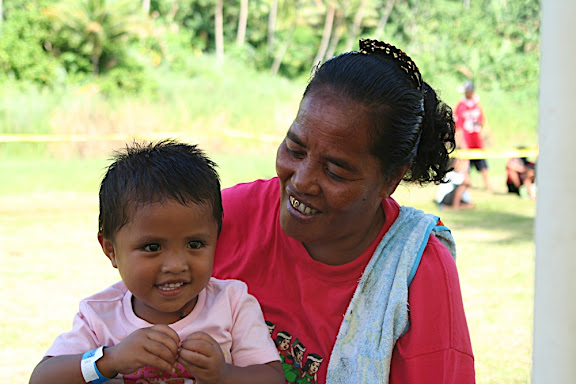
Today is more of the same, so I'll cut to the chase and talk about my lunch break. The local women have made food for us at the pastor’s house. I am let out of the fence around our church basement clinic by armed policemen. I cross the street, and go up the stairs of an oceanside house made of sturdier material than the other homes in the village. There is a huge porch in back on the beach and another in front facing the church. There is a spread of food out on the table with many women in floral print dresses offering me food. I pass on the more exotic foods and head outback to enjoy my MRE (meal ready to eat, see prior post).

The view is spectacular. It’s no less beautiful than the waterfront I’ve seen in California or Florida. Dozens of kids play on the beach below. They again perform antics when I take pictures of them. Foolishly, I ask one of the women where the bathroom in the house is. After some confusion is resolved, she points outside.

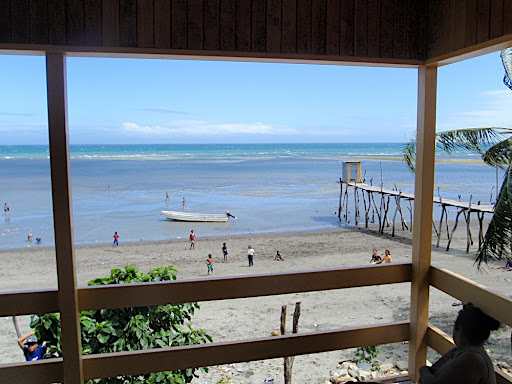


There are makeshift walkways extending into the ocean, about every fourth house. I had seen these before but just assumed they were docks for getting a better view of the ocean or for pulling a boat up next to. (Go ahead and look at the picture up above and you probably thought so too.) But upon closer look, I saw that that at the end of each was not a boathouse but an
outhouse. I watch for a minute for the next customer to arrive. A woman goes in, and a minute later something drops out of the outhouse and into the water below. Not even twenty feet away is a group of 3 children running naked playing in the ocean.

I remember a patient from that morning. It was a mother claiming that every time her 3 children go swimming they get an ear infection. Good thing I gave her antibiotics.


I walk back through the house and the women on the front porch have broken out into spontaneous song. The sound is truly magical. They are harmonizing and singing in counterpoint. Invigorated I head down and finish seeing patients for the afternoon.


--pete

Tuesday, August 26, 2008

The Numbers Are Staggering

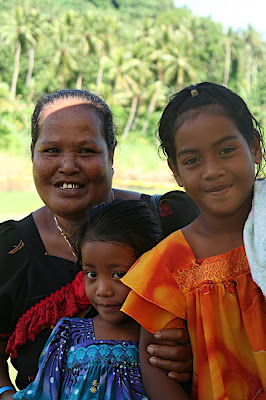
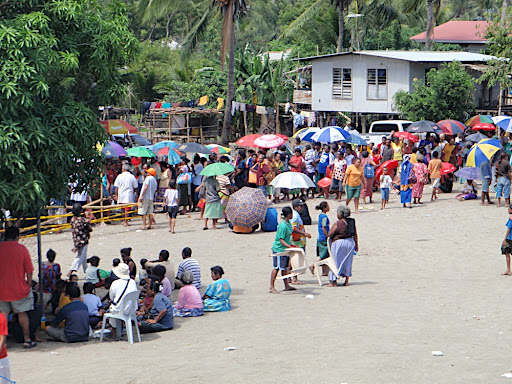
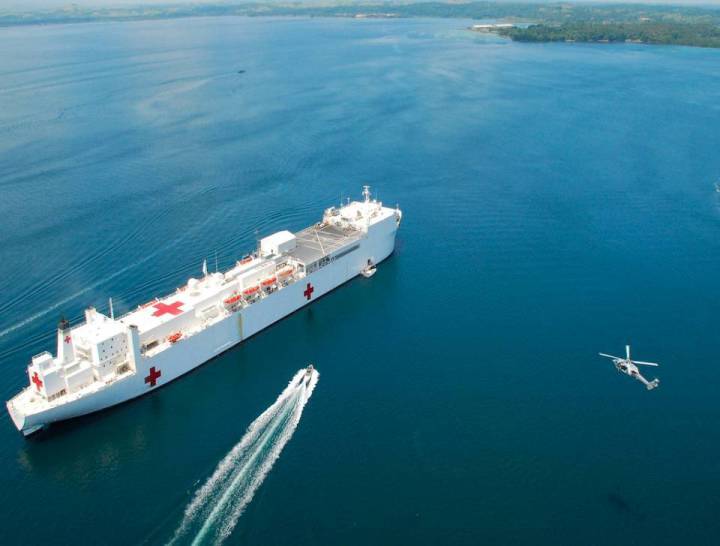
It is striking how loving and appreciative the people of Papua New Guinea are. As we get near to the MedCAPS [read: medical civilian assistance program sites] people from all around begin to line the streets, some are locals, others travel for miles—usually by foot. They are waving, smiling, even running with the bus. It is the biggest event that has ever happened for these communities in quite some time. They have seen our huge ship in the middle of their harbor, anchored in the deep water with boats constantly transporting us back and forth, and now we are finally here in THEIR community.

There is a palpable excitement that is contagious throughout the community, from the children to the elders. As we get closer to the site (usually a church, school, or public building) a line materializes amongst the crowd that is as much as a few thousand people strong. When I first saw this I looked around the bus: 10 doctors, me (a med student), 5 nurses, 2 dentists, 4 dental assistants, 4 optometrists, 1 chief of operations, 5 security guards. How were we going to see all these people?

I turn to the doctor sitting next to me, “don’t worry, you’ll be able to see more patients than you ever have before” he reassured me.

The reason for this is that these encounters are not exactly like those in the US. We are giving goal-oriented medicine, that is we are 1.) looking for the truly sick individuals in the community so that we can get them to the ship for treatment where we have a full staff, equipment, medications, ancillary services, and surgery rooms, 2.) keeping an eye out for people with infectious diseases like TB and HIV (so that we can refer them to public health at Port Moresby General Hospital where they have free resources and medicines to help treat them), 3.) limited by a formulary that consists of a handful of antibiotics, NSAIDs, OTC’s, some topicals, multivitamins, and a handful of other meds, 4.) not looking to cure chronic disease as we will only be here for a week longer, 5.) trying to educate patients on better health practices, hygiene, and nutrition. With these constraints and goals in mind, encounters for lower back pain can be rather quick, whereas the truly sick patient or surgery consult patient may take a bit longer.

We make our way through the masses of people as they reach out to touch us, give us high-fives, and occasionally a USA chant is heard. I can’t help but smile. We set up and open the doors to the patients to come in. We are pumped up and ready. It turns out he was right, by the end of the day our medicine group saw 864 patients, dentistry saw 112, and optometry about 409 (1385 in all!). I worked as hard as I could, barely eating lunch, and contributed a meager 64 to that number, but wow what an impact!


Bon Voyage,
~Nic

Monday, August 25, 2008

On Caring

The question has been proposed at times, "How can a temporary mission like this really make a difference?" Even worse, how can 1-3 week whirlwind missions really provide any permanent medical change to communities and countries?
Do the medical visits, surgeries, preventative measures done by the USNS Mercy team really help anything?

The following story does have a point:
After the church service yesterday, one of the community announcements was regarding one of the Navy officers who had just lost her brother, and must return home.
At the end of the sermon, we sung a song about how we are cared for. Some lyrics:

And He walks with me, and He talks with me, And He tells me I am his own,
And the joy we share, as we tarry there,
None other has ever known.

After the song, she stood up, tearful, and shared her story:
Growing up, she lived on an island 2 miles by 16 miles long, much like some of the small islands we have been visiting. Her parents would be at work all day, and she and her brother would stay with her grandparents. There was no electricity, no television, a small handheld radio.
One day a "big American" came, and at their local school provided some basic dental work, pulling teeth, handing out toothbrushes, as our dentists during this mission have been doing.
And even though they didn't do any fancy surgeries, their visit changed her life and affected all the people on the island.
What made the difference wasn't so much the medical assistance, which was minimal, but was the knowledge that someone out there cared about her. The knowledge that there are people in another country who would travel such a long distance to come help their little island.

And so she said, even if you think you didn't do anything, even if you think we didn't make any grand changes, I am living proof that you did make a difference, by coming to help because you cared about these people.

In the end, it seems that I've been thinking about this all wrong. It's true, sometimes we can make a medical difference, and sometimes we can't. But there is isolation and hopelessness everywhere you look in the world. And perhaps one of the roles of a physician can be to bring some caring and hope to people who may have neither.


-ryan

Sunday, August 24, 2008

first day out.... Gaire village, PNG

I’ll try not to duplicate material from the other posts here. What I have tried to do is give you a play by play of what it was like to go on a "away mission" off the Mercy and into a foreign country to see patients under the protection and supervision of the US Navy. I’ve put pictures and descriptive words to help you see the sights and hear the sounds. My experience is ideal for this because I was at one of the most remote locations. This was, literally a seaside village of a few thousand people.

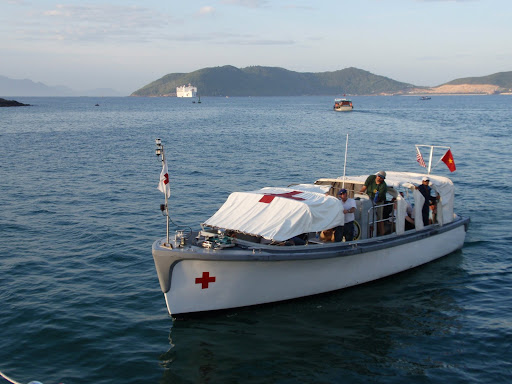
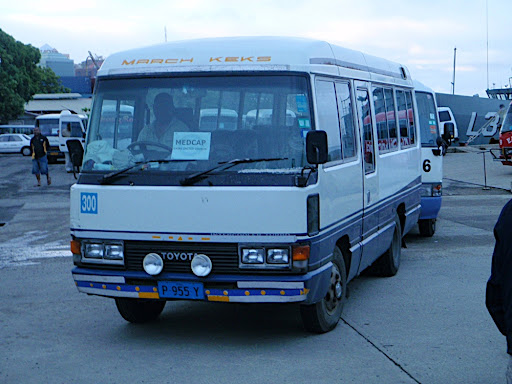
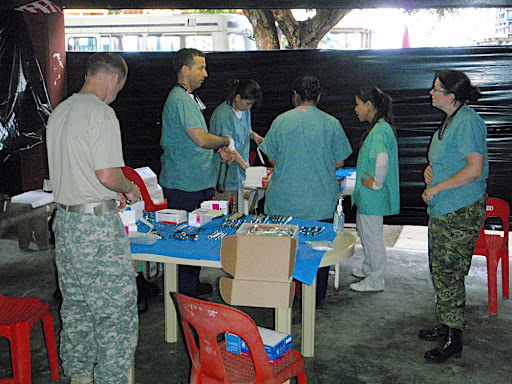
It’s my first day off the ship… finally! Up at 5am. The water is rough as I climb aboard the band-aid 20-person boat (shown at left). On shore we open up the storage lockers and load our pallet of supplies onto two pickup trucks. Then we climb aboard 2 buses (shown right) and caravan our way to a seaside town 40 minutes away. Our team is composed of 20 or so healthcare providers: doctors, nurses, dentists, physical therapists, and military hospital corspmen along with a 10-person security force complete with guns in hand.

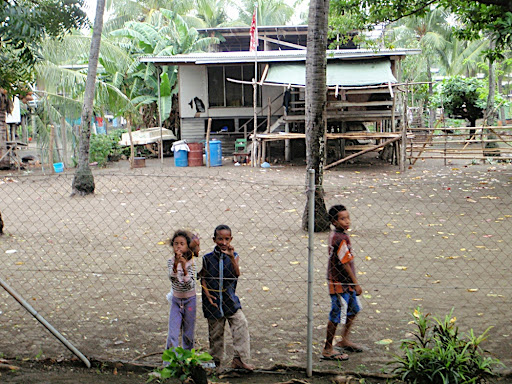
Soon we are in town. The houses are approximately 20x20 feet, and all are built up on the second floor. My best guess is that this is because of termites because even the hilltop ones are built like this so it can’t be on account of the rain. They are made of wood and tin. All have cooking pits on the ground beneath them. (That explains all the burns we have been seeing.) There is a great deal of excitement and bustle as we ride in. Kids run up to the buses in the street yelling and cheering. Everyone waves. There is a lot of cheering and a general feeling of excitement hangs in the air.

Our clinic today is the open-air first floor beneath a church. We exi
t the bus and start setting up shop while a man with a loudspeaker gives a grandiose speech first in the native language and then in English. After hearing stories of thousands of people lined up I am surprised that we have just a small crowd of maybe 100. I wonder if we will have enough business for the day. My intuition turns out to be wrong as we have a steady stream for the next 3 days. There is a small wire fence around the church basement, and all around are the houses of the village.

Children are playing and peering through from the fence. Small, scrappy dogs are running around. When I take out my camera, all the children cry out to get my attention. They perform antics and make funny poses trying to get me to take a picture of them. I see what I think is a mosquito and immediately slap on my REI bug juice. Malaria, which is transmitted by a bite from a mosquito, is endemic here.

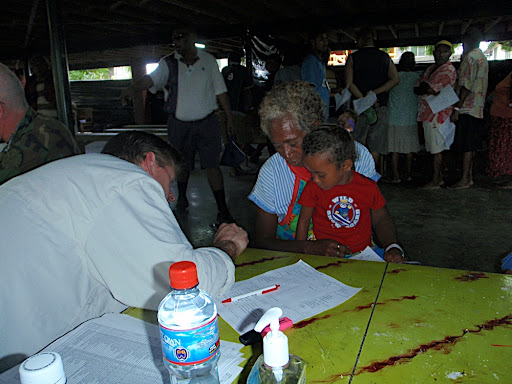
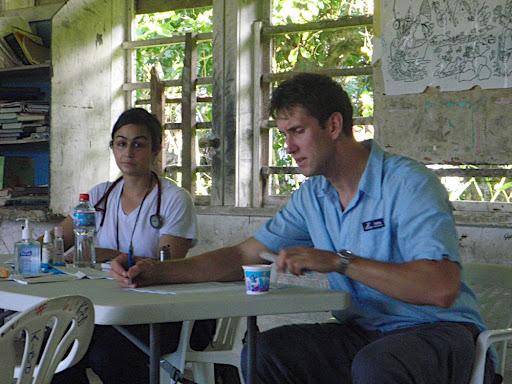
I am excited but also nervous. I get one of the “provider” spots at a table, with an experienced doc right next to me in case I need to solicit any advice. She is a dermatologist, an indispensable resource for this situation due to the abundance of skin complaints. She flies through patients. Interviewing, diagnosing, explaining, prescribing, and then sending them off as she yells “next patient.” I get off to a slow start. I do everything I’ve been taught. I smile as I introduce myself. I ask lots of questions. All this is done through a local man who is serving as a translator and so the process takes lots of time. I am glad to have my dermatologist for backup.

Soon I realize that this isn’t the same breed of medicine that I am used to seeing in the US. My job is to find the truly sick people and do what I can to help them out. If someon
e sounds like they have TB, I tell them adamantly that they need to get treatment at one of the free clinics on the island. If I think they have malaria, HIV, or are pregnant they get tested by our lab and receive an answer on the spot.

At least two-thirds of my patients are there for back pain. It’s no surprise
given that the women carry huge jugs of water atop their heads from wells and streams back to their homes, and men go out and gather firewood and return with it on their backs. I give the “low back pain” lecture countless times. Keep your back straight when you bend down. Use your knees to lift the weight. Stretch your hamstrings. Keep your stomach muscles strong. Don’t work so hard. Wear shoes when you have to walk long distances. I warn them to stop using Motrin if they have stomach pain. (A well-known side effect of that drug is stomach ulcers, something Vioxx tried to fix but that caused other problems.)

I am surprised that almost all the patients are happy at the end of the encounter. They th
ank me graciously, even when I have to conclude with “I’m sorry that we can’t do more for you.” It’s a very different experience than treating people in the US.

And so I make it through my first day, having seeing fewer than half as many patients as the dermatologist at my table. Then it’s back onto the buses, a caravan back to the port, and a ferry boat onto the Mercy. I eat a ton of food for dinner and immediately go to bed.

--pete

Saturday, August 23, 2008

Zebras and the Kokoda Trail

Last day of on the boat service. Our direct report is finally back from his week-long mission ashore running daily medical clinics. We casually stroll into his office at 9am. He is a pleasant surprise. Smart, professional, and frank.

I hang out in the area of the boat known as CasRec (short for Casualty Receiving). You can probably guess what this room is used for when the Mercy is serving as a military hospital ship. On this mission, however, this area functions sort of like the ER would in a US hospital. Every patient that comes on or off the boat goes through here. Some are straightforward. Most are not. All are very pleasant and grateful. An easy patient would be one scheduled for a surgery. They have already been seen by their surgeon-to-be back on shore. A history and physical has been done. Admission orders are in the chart. They are just of here for an appointment. Their vitals are taken and they are taken to the Pediatric or adult floor beds.

Many of them have no appointment but have managed to talk their way into being seen in CasRec. I see one of these. He was part of a tour group of national government employees that is onboard for a tour, one of the mainstays of the diplomatic side of the boat’s mission. He is a 33 year-old man who is a driver for the national embassy in Port Moresby. His chief complaint is knee pain. Approximately 100% of the adult patients here have knee pain. This is not surprising. They walk everywhere. They have no cars and no buses. They often have no shoes except for simple flip-flops much like the pair I brought along on this trip to wear in the shower.

His story is classic for osteoarthritis, the medical term for wear and tear of a joint. His pain is worse at the end of the day. My interview is interrupted by my Attending. I think this patient should get some Motrin and perhaps a nice pair of athletic running shoes with lots of cushioning. My attending orders a knee X-ray, writes a script for Aleve and Tylenol, and arranges a visit to Physical therapy on the boat. Aside from merely observing surgical procedures this is my first clinical encounter yet on this trip, and it doesn’t feel all that much like international medicine.

I see that patient later in the afternoon after he has received his battery of services on the boat. He is very happy. I guess that shows what I know. Maybe we did make a difference for that guy.

We see another woman from one of the tour groups. She complains of headaches. She is given a referral to optometry. (As anyone with an outdated prescription on their glasses can tell you, blurry vision can cause headaches.) She also asks that her bloodwork be analyzed. Her request is granted. A vial of her blood is drawn by a Navy corpsman and sent to the onboard laboratory. The levels of sodium, potassium, chloride, and calcium in her blood are analyzed. Her red blood cells are analyzed, counted, and sorted. Their shapes are characterized and statistics generated to report all this information. In the end her vision is fine and her labs are all normal. I do not catch-up with her in time to see what my attending does for a discharge plan.

The rest of my day is spent trying to catch wind of the cases that need more than vital signs taken and see those patients before my Attending gets to them. Near the end of the day I see a girl with an obviously deformed face who is heading to ophthalmology. My medical training provides almost no exposure to ophthalmology so I am eager to get some exposure to that while on the boat. I run to catch up as she is taken there with her mother and father.

I leaf through her chart. Her working diagnosis is right cranial nerve 6 and 7 palsy. That means she cannot move her right eyeball in 4 of the 6 cardinal directions (CN 6) nor does she have use of any of the muscles of facial expression on the right half of her face (CN7). She cannot close her right eye. She cannot smile. She cannot hold her mouth closed so that she constantly has drool falling from the right side. She was brought to the boat primarily for CT imaging of her head and neck. The most likely diagnosis is a brain mass. Now I’ve skipped a few steps to arrive at that conclusion so I’ll digress for a moment to explain.

Medicine is a game about most likely’s. They say if something has four legs and grazes in the field it’s probably a horse and not a zebra. Don’t look for zebras is what we’re taught, unless of course you’re taking an exam in which case the zebra is probably the answer.

If this girl’s right eye worked fine she would not be on the boat. An isolated cranial nerve 7 deficit is called bell’s palsy. That would be the most likely cause. It could be diagnosed by most any competent 2nd year medical student. It is very common. It can happen from disease, infection, or simply spontaneously. Sometimes it gets better; Sometimes not. The treatment is steroids, not like baseball players take but hydrocortisone like my Grandmother takes for her rheumatoid arthritis. But this patient also has a CN 6 deficit. That’s a different story entirely. Now the most likely pathology (problem) is a single lesion that is affecting both CN’s 6 and 7. Harkening back to anatomy, the only place where those two structures share a common pathway is inside the brain, and in particular the brain stem.

So now we are talking brain lesions. That means tumors, infections, and bleeding blood vessels. This is all pretty serious stuff with big-time consequences. Getting an image of this girl’s brain to see what is going on in there could save her life, even if we don’t do the surgery or treatment she will need during this mission. It could mean the difference between catching a tumor when it is small and easily operable versus catching it too late when it has grown and even spread. In fact, this kind of imaging technology is one of the ways the Mercy can really make an impact in a short time.

A patient found on one of the away missions who needs medical imaging to further the workup is a great candidate for a referral to the boat. The cost of doing a CT or X-ray series on the boat is relatively cheap. Well that’s not really true. The true cost is high, but the incremental cost of doing an additional image is small. We already have the machines, the people to service them, the people to operate them, the nursing staff to prepare the patients, and the radiologists (physician’s who trained for 5 years post-medical school) to interpret the images we capture. That money has been spent. So ferrying out one more patient from the shore to the boat, checking her in, taking her vitals, and doing one more CT scan is, so to speak, inexpensive.

However, the CT scan of this girl is a surprise. There is not identifiable lesion. Now what? The pediatrician is unsure so she sends for an ophthalmology referral. That’s when I joined the case.

She is given a standard vision exam, exactly like what you get when at Walmart when you see the optometrist. The difference her is that her father is translating and she apparently doesn’t recognize the letter Z which comes up very frequently on the exam. I’ll have to remember later to check whether that is in the PNG alphabet. The exam shows she needs some low-power reading glasses, but that the sight functionality of the right eye is 100% intact.

Several phone calls later and we are speaking to the head eye surgeon. First of all, his OR schedule is full for the remainder of this mission. That’s not so bad, though because even if it weren’t, even if this girl were say in the US instead of a boat in Port Moresby harbor, the optimal management of her case would be to wait at least 12 months from the onset of her symptoms before considering surgery. This is because in a significant number of cases the symptoms spontaneously improve, and thus the patient is spared an unnecessary trip to the operating room.

So this patient needs an MRI. It captures images with a magnet. No radiation. But even with all our technology we haven’t found a cost-feasible way to house a 2-ton magnet strong enough to detect images down to fractions of a millimeter on a metal ship that traverses through 20-foot open ocean swells. In fact, many smaller hospitals in the US don’t have an MRI machine on-site. They cost over $1million. It is very common to see mobile MRI trailers parked outside a hospital, hitching up to a big-rig and bringing their imaging power on the road as needed. Unfortunately for this patient there is no MRI machine in the nation of PNG. 7 million people. No MRI machine. The pediatrician goes to work filling out the necessary forms for the Australian rotary club. This is a non-profit group that works to obtain medical services for PNG-ians using the resources and infrastructure from nearby Australia. The patient’s medical history is taken down in great detail to fill out the forms with 100% accuracy lest some oversight be a cause for denial of her request.

So that’s it, the patient is ready to go. But first, something that is very common on this trip happens. The doctors and nurses take pictures of this patient. I always found this part of medical culture to be a bit odd, this fascination with the most deformed and grotesque manifestations of disease. Yet medical types love it. They seek it out. They have chosen careers dedicated to the alleviation of human suffering and yet they are obsessed with witnessing the most terrible forms of disease that can be found. I wonder what these people will do with these pictures. Certainly they will download them onto memory cards and onto iPods and laptops. Perhaps they will share them with others on the boat as the captain did this morning with me. Maybe it’s good. Its part of the teaching culture of medicine. It helps educate everyone else about something that happened in a distant part of the world.

The patient’s parents are very thankful at the conclusion of their visit. Not to mention that they had perfect manners throughout their encounter. Despite waiting for the better part of the day for the various tests to be conducted on their daughter they never complained. Had I not asked whether they were hungry at 4pm they most certainly would not have mentioned that they had not eaten the entire day.

I run into one of the general surgeons after dinner. He was ashore today. He describes the multitudes of people he saw and their deformities: broken bones that were not treated properly and so they never healed right; arms that bend in three places instead of just at the elbow; a shin bone that is poking through the bottom of a heel ever since the patient fell out of a tree years ago. All of those patients would require multi-stage surgeries to correct their deformities, and this is beyond the scope of this mission. They would need highly skilled nursing for months following their procedures. That is also out of the question. He concludes saying how he was impressed that all those patients were still very grateful for whatever medical services were provided to them. He says that people in the US don’t know how good they’ve got it. I agree.

The briefing is more exciting for me tonight. Tomorrow is my first day off the ship. I pay more attention to what’s being said. I check and double-check my wakeup time and muster [read: assembly] location.

The feel-good message of the briefing tonight is about the Australian hiker again. She has made it past the critical stage of her illness (she suffered severe hyponatremia with sodium levels as low as 118). Apparently the story has caught on in the press. We are shown the Google screenshot that boasts an impressive display of news articles for her name as the search term. Congratulations to the boat’s crew are again extended. (Capt. Wiley has a good summary of what happened in his blog)

The commodore’s speech makes sense to me. I like him. I think he really gets the big picture. His message tonight is about how all the diplomatic efforts from the early part of the mission are paying off. The country’s head of state toured the boat today and had nothing but the highest praise to offer. He said we are making a difference and leaving a positive impression on everyone on the island from its highest ranking official to some of its poorest citizens. He is right. I have the thought that this mission is not attempting to solve the medical needs for all PNG’s citizens. It’s about paving the way so if someone cares enough to come back later, they will be welcomed with open arms.


~Pete

Friday, August 22, 2008

Tattoos

Talking to some of the student and church volunteer interpreters I get a glimpse and perspective on the culture and traditions here in PNG. One such tradition is a right of passage for women in which they receive customary tattoos with designs from their family and tribe upon their first menses. I met many women with these tattoos in various locations with intricate, but now fading designs. Facial tattoos were the most striking, but tattoos on the hands and arms were also common. The interesting thing was that rarely were there any young girls that had tattoos.

The youth (whom I would have thought would embrace tattooing as they do in the US) rarely if ever had tattoos. I asked an interpreter why, and she said that many of the younger generations do not want to be associated by the tribal customs. “Nobody does it anymore around here,” she explained.

A grandmother who had tattoos along her arms told me that the patterns in her tattoos represent her family and community where she comes from. I asked her why her daughter doesn’t have similar tattoos, to which she replied, “I tried to but she had too much pain. Nowdays people are not as strong as before.”

It seems that wherever I go, American culture, ideals, and traditions are mowing over and often replacing those foreign nations. It’s a shame and it seems like we are tainting the world with our capitalism. But when you talk to people, they embrace it, want and yearn for US culture. Maybe it comes from the “grass is greener” phenomenon, or the idea of mimicry and emulation that propels people to improve or assimilate. But there is a subtle tragedy regardless if it is forced or not, in the sense that slowly these beautiful traditions and cultures are loosing what made them unique, that which took years and generations to develop. Almost the same way you hate to hear about endangered species slowly being erased from the senses of species. Maybe it’s a survival of the fittest mentality that improves success and living standards, and maybe for the individuals it’s for the best, there is just something that irks me about this trend. But who am I to judge, my father immigrated and assimilated in part to America and the culture for a better life for him and his family.


Bon Voyage,
~Nic

On Crowd Control

At both of the MEDCAP [Medical Civilian Assistance Program] sites I've been to, I've noticed a peculiar thing. At the end of each of the days, the children would, perhaps understandably, go nuts. They would either storm into the site and try to play "touch the American" or "please take a picture with us" or crowd around the buses and try to get our autographs (crazy but true).

However, there would always be a man who did crowd control. He would have a very large stick, usually a large tree branch, and swing it at certain kids he decided were unruly enough to warrant such a punishment. It would be at random kids too, since almost all of them were almost out of control.

The best part was, this guy wasn't associated with us. He didn't have security uniform or a volunteer t-shirt on. It was just some guy from the local town, who came by with a big stick and decided to start swinging. At another site, someone observed a woman fulfilling this role, only she was using a banana peel rather than a stick.

Maybe we should've hired the guy, hahah.

You know you're in an interesting place when its okay for a local man to run around trying to hit kids.

~Ryan

Settling In

I wake up late and rush to catch the end of breakfast. I run into Sonia. We talk for an hour or so, mostly about medical specialties. Then she is off to meet someone and I head to the OR.

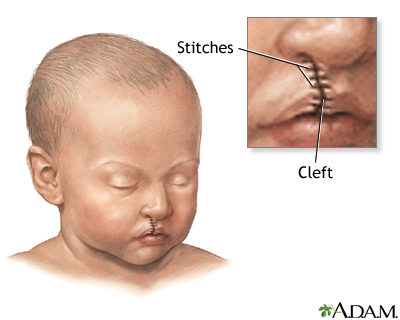
The plastic surgeon I worked with the day before is there. I reintroduce myself and soon I am suited up assisting with a cleft palate repair. During the procedure all sorts of medical and dental folk wonder into the room, They ask questions of the surgeon. The push to get a good view of the procedure. They talk shop. Because this is a more involved procedure than a cleft lip this patient will spend another 2 days aboard the ship where she can be closely monitored for post-op complications like bleeding, or breakdown of the sutures.

Then onto lunch. Sonia informs me that we have permission to leave the ship. We catch the next ferry boat to the dock, where there is one guy selling stuff out of the back of a pickup truck. I buy some stuff figuring this might be my last chance at getting any souvenirs. Then it’s back aboard the next ferry and onto the boat again.

At dinner I meet more people. Military personnel. Project Hope doctors. Pre-dental volunteers from San Diego. The hot topic from everyone is their experiences from the away missions. Hundreds of patients seen by 5 providers. Arriving at a clinic site and being greeted by thousands of waiting cheering patients, such that it feels like finishing a marathon. Stories of regret for the hundreds of patients left waiting in line at the end of the day that did not get seen, some of whom had been waiting since 3am that morning.

All of the returning away mission personnel look tired. But they are all happy. They are living the dream. They just spent a day toiling at the thing in life that they are passionate about. The thing they spent thousands of dollars in airfare and months of time away from their families to be a part of.

I will not be participating in any away missions for 4 more days. I am frustrated. I am disappointed. Then I am mad at myself for thinking these things. This isn’t about me. It’s about all those people waiting in line to be seen. I resolve to prepare myself as best as possible for when I finally get to go off-ship. Someone from dinner said they saw 60 patients. I will see 70. Hell I will see 700 if they would let me.

~Pete