

Tuesday, September 2, 2008

Hailed like gods

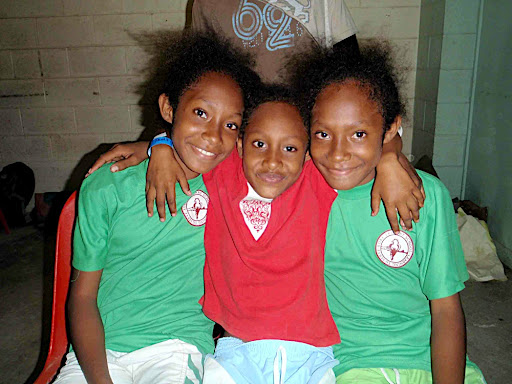
The last day of the MedCAP visit before we are done seeing patients or even packing up the people began to shower us with gifts. One thing that was consistent throughout every day of the MedCAPs was how appreciative and thankful the people were. Even when I could do nothing to help a woman’s breast cancer, or was baffled with the old man’s Parkinsonian-like symptoms without any evidence of Parkinson’s disease, or the child with what looked like treacher-collin’s syndrome; even when all I did was give Tylenol for a wife with lower back pain from carrying water, multivitamins and cough syrup for a child with cold symptoms, Aleve for a man with osteoarthritis of the knees, the people were grateful beyond belief. They shook my hand fervently saying thank you with a look of relief on their faces. Some of my patients came back later in the day with gifts to give me: hand-made bags, shell and seed necklaces, and even a model of a traditional trading boat called an “Abotouey,” which is their traditional trading boat previously used to trade throughout PNG (ie fish and shells for sego palms, yams, coconuts, tarro, etc). She seemed to have a bit of a crush on me. I am told that on independence day they parade around with these boats. A few of the volunteers asked for my contact information so that they could write me at home. Some came up with a pen and asked us to sign their t-shirts. Others wanted pictures with us (they did not have a camera, but wanted to be in a picture with us on OUR camera). And one girl shyly approached me as we were packing up and asked me to have her volunteer translator name tag—I gave her my American Flag pin from my shirt and said thank you. Her friends were huddled to the side of the walkway watching the transaction, giggling. We finally got everything packed and exchanged final thank-you’s as we got back in the busses. I sat in the back row looking backwards as the crowd chased after our bus smiling and waving. I can’t help but think that we were being revered higher than our credentials, I mean it sure felt like we were hailed like gods. A warm sensation of accomplishment and satisfaction glows from within. We helped a lot of people, we saw even more, and we showed a small community in the corner of the globe that we care about them, so much that we traveled this far with so many people to make their lives just a little better.


Bon Voyage,
~Nic

On International Aid

One of the obvious reasons for coming on this trip... obviously... was to provide some medical care to the people that otherwise had no access to "standard" medical care. And hopefully, the care we provide would be quality medical care that we would be proud to give back in the U.S.

Of course, I now know my expectations were too high, and my assumptions were wrong.

One typical scenario would be a patient that had been seen by the local doctors many times, perhaps even at the general hospital. Although the treatment was at times inexplicable, i.e. antibiotics for osteoarthritis, the diagnosis was usually correct. The problem is that they would come to us for help, and we would have no treatment to offer. Torn meniscus, endometriosis, hepatitis, schizophrenia, on and on. The American doctors that have come from thousands of miles away, who were assumed to be better than their own local doctors, had nothing to offer.

The other scenario is a patient with a chronic and very often serious problem, who would come for treatment. At times, they have walked for 10 hours, and stood in line since the night before to see us. Not only did the patient have high hopes, it was a lot of pressure on the provider to help someone who comes to you at such great cost.

But as it turns out, it's difficult to treat ALS or a cerebellar stroke with NSAIDS and antibiotics.

How do you, in essence, turn away a patient who comes to you as their last hope? How do I tell a patient to go to the general hospital when they have no resources or support?

Maybe one day someone will be able to come back, and really help these thousands and thousands of people that desire so strongly for relief from their, at times, treatable ailments.

But how could you really help these people substantially without a complete overhaul or even creation of a medical system? One provider couldn't even make a dent. And how can you create a complete medical system without a complete overhaul of the social and economic systems already in place?

Someone please figure this one out. Thanks.


~Ryan

Monday, September 1, 2008

The gifts we bring

The translator who worked with me all three days brought me a handbag on the last day. He said his wife made it, but I later heard rumors that many of the locals bought the gifts they gave. A handbag like that goes for $25 American. The average monthly household income in PNG is $100. As for me, I brought no gifts for anyone. To be honest I didn’t even think about it. When I was frantically packing back in San Diego, the thought never crossed my mind. For the rest of my outings while aboard the Mercy I made it a point to bring at least some small item to give as a gift.


The San Diego congresswoman Susan Davis visited the ship during the earlier part of the mission before I arrived. Apparently she had gotten many calls and complaints from her constituents who were upset that they could not get appointments because their doctors from Balboa Naval Hospital were away on this trip. She said she wanted to see for herself how American tax dollars were being spent, given that they were pulling resources away from her community of taxpayers and voters.


My point is how easy it is to lose perspective. I don’t think the naval hospital patients in San Diego, myself, or our Congresswoman are bad people. No one could fault any of us for how we acted. However, when we look at the larger view our actions seem perhaps less than noble. Maybe it’s OK to wait to see your dermatologist or to see a different one for a while if it means some people in a village in PNG can get basic medical care. And maybe it’s better to bring gifts instead of extra workout clothes and protein powder when you visit a new part of the world.


--pete

Sunday, August 31, 2008

Tatana Village

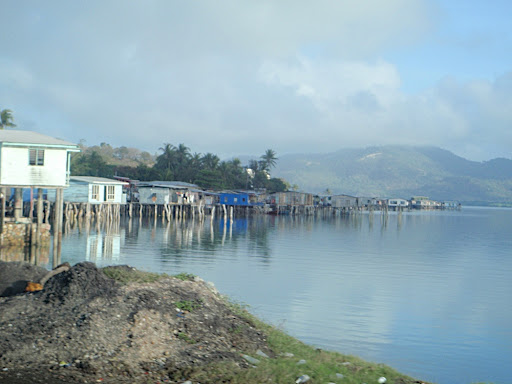
MedCAP [read: Medical Civilian Assistance Program] to Tatana, day one. Tatana is a small island community connected to mainland PNG by a small land bridge not very far from Port Moresby. It is a mountain shaped island with most all inhabitants living on the water's edge on stilted houses. Interestingly there is no fresh water is available on island as such they must trek water in, a job done solely by women, hauling 20L tanks of water to and from the water tank/well. People are very close with each other, they are forced to be close, living on a small island necessitates that. So they all talk about ecah other like gossip you might hear at lunch in high school. Children flock together and play like as if a kabbutz. It is a beautiful village with a great view. The people were exceptionally nice, many of them make what money they have by fishing.
I set up shop on a table up stairs in the church hall next to the window with a view of the water and windows that let in light and a cool sea breeze. The day went by so quickly, it seemed like I had hardly started seeing patients when the end of the line found its way inside.
The next day I returned to Tatana, getting a warm greeting from the community just like before. Outside, next to the line of people looking for medical care is a group of people who needed no further healthcare... I say this because they were strong young men playing a very competitive game of volleyball, the likes of which would hold its own weight even on the sand courts of Mission or Huntington Beaches. This day my personal goal was to give everyone smoking and betelnut cessation advice. This is on top of the ergonomics, exercise, and stretching counseling I would give everyone I wrote NSAID treatment for. Ergonomics is a big problem here--the woment stay hunched over for long periods time doing repetative tasks such as washing clothing. They do so on the floor, sitting crossed-legged, leaning forward rubing the clothes inside a big bowl of soapy water in front of them. What you will never see is them put the bowl on a table so that the whole operation is at elbow level.
Later that night we tried betelnut with Sonia--it was her last night. Betelnut is chewed with much ritual. first you shuck the betelnut, exposing the seed which you can pack in your cheek. Next you grab a kava (member of the pepper family) seed pod and lick it, dip it in Lyme (Calcium Carbonate) and add that to your mouth's mixture. Once the chemicals combine you start looking much closer so someone with red paint in their mouth than anything else. The stuff gives you a quick buzz, lightheadedness, flushing, and increased heart rate--but most of all it causes you to perpetually spit nasty red looking stuff. I know its terrible for you. I saw people all day long who had dental and oral medical problems, even cancer, from chronic betelnut chewing. Nonetheless, we couldn't leave PNG without trying it once. (I understand the irony of this in relation to what I wrote in the previous paragraph) Needless to say, I'm quite sure that this was the last time we tried the stuff, it tasted like stink and left your mouth feeling like you just chewed on a piece of chalk.

Bon Voyage,
~Nic

Saturday, August 30, 2008

PNG: Lost in Translation

My goal for today was to see greater than half as many patients as the ER doc I was working alongside. I was really in the flow and rhythm of seeing patients, when a man with an unusual problem came to my table. He was very short-stature, probably no more than five feet, and his body was childlike while his head was normal-sized and fully-matured. In medicine we would say that he looks “syndromic” meaning that he probably had some sort of genetic or congenital disorder like Down’s or autism. If you’ve ever seen anyone with Down’s you would probably agree that they have a characteristic look. However, since there are hundreds of these syndromes and they are tough to remember, only a few physicians whoa re experts in identifying these disorders remember them all. The rest of us just say the patient looks “syndromic.”

So anyways the patient sits down and I ask him if he takes any medicines. He does not respond, at which point the translator intervenes and tells me that, “This patient is deaf and mute,” and so he cannot speak or understand me.

“OK fine” I say. Then reflexively I switch to using the translator mode. “Can you ask him what medicines he takes?” I say.

The translator then proceeds to act out my question to the patient without using sounds, as if he were playing charades. He motions about putting things in his mouth, presumably to mean taking pills. Satisfied that he was understood next he points his index finger at the patient indicating that he wants to know if the patient takes pills.

The patient nods in understanding and shakes his head “no”.

“He doesn’t take any meds,” says the translator.

--pete

Friday, August 29, 2008

On Silence

A citation from Pathologies of Power:
"Dr. Plarr was a good listener. He had been trained to
listen. Most of his middle class patients were accus-
tomed to spend at least ten minutes explaining a simple
attack of flu. It was only in the barrio of the poor that
he ever encountered suffering in silence, suffering
which had no vocabulary to explain a degree of pain,
its position or its nature. In those huts of mud or tin
where the patient often lay without covering on the dirt
floor he had to make his own interpretation from the
shiver of the skin or a nervous shift of the eyes."
Graham Green, "The Honorary Consul"

I have often found that many of the patients in the poorest situations have been difficult to communicate with because of they would not volunteer information, would not express their complaints. I never knew if they lacked communication skills or they simple did not wish to speak or complain. In the case of non-english speakers, it could have been the language barrier.

This has also been very true in this part of the world. In Papua New Guinea, one of the pharmacists remarked about how "stoic the people in this country are." People will have suffered incredible injuries or illnesses, and will not express what I would have considered "the appropriate amount of concern." One lady complaining about a headache didn't even want to mention to me her huge draining abscess-looking-thing on her index finger. I, of course, freaked out. Her response was something like, "yea, it hurts."

Initially, I thought: I guess these people would have to be stoic to put up with all the difficulties they deal with. This includes having to walk everywhere for hours at a time, the resulting knee and back pain, not having enough fresh food available, a failed social services system, the terrible terrible heat and humidity, lack of sanitation, high crime rates, etc.
However it has come to my attention that this subject has been thought about before, and I can put it no better than the eloquence of Paul Farmer (sorry it was so long its paraphrased):

You don't have to be a doctor to know that the degree of injury, of suffering, is unrelated to the volume of complaint. I have seen the sullen, quiet faces in waiting rooms in Peru, say, or in prison sickbays in Russia.
Members of any subjugated group do not expect to be received warmly even when they are sick or tired or wounded. They wouldn't expect Dr. Plarr (from above) to invite a long disquisition about their pain. They wouldn't expect the sort of courtesy extended to the priveleged.
The silence of the poor is conditioned. To describe as stoic is not to be wrong, but rather runs of the risk of missing the great eloquence beneath the silence.
~paraphrased from Pathologies of Power

I could say something here, but I will just leave this with the power of those sentences.

~ryan

Thursday, August 28, 2008

PNG Key Points

This is an excerpt from my PNG Gaire experience. I included it here because it makes several points. On my first day I saw a woman with sarcoidosis. Briefly this is a rheumatologic condition (like lupus or arthritis) that has no cure, gets worse with time, and imparts rather sever disability on those afflicted with it.

This woman was in a wheelchair. She traveled two days from a neighboring village to be seen by us. She had to be pushed along the concrete floor in our clinic so I have no idea how she made it several miles from another village.

Point 1: many patients traveled several days and/or waited in line for many hours to be seen, but not a single one of them complained.

She had her medical record with her. She had been given the correct diagnosis at Port Moresby hospital. I thought she had received the correct treatment with prednisone, but the dermatologist in our group said methotrexate was better. The dermatologist showed me the relevant physical exam findings for this disease and then she took photos of the woman. These were to show the dermatology residents she taught back in the US, most of whom would never see a live patient with this disease in their 8+ years of medical training. The dermatologist did some education for the woman about her disease, left several therapy recommendations in her medical record, and sent her on her way.

Point 2: Many of the people here had a small notebook that had their medical history in it. This aided greatly in helping to get their story right, and (I think) it sometimes helped to move their case forward because we could leave recommendations from our experts for therapies that local doctors could carry out.

So in the end we didn’t do much for this woman except to give her information about her disease and to facilitate her getting the optimal therapy for her terrible illness. She thanked us and left with a smile on her face, ready to set out on her multi-day journey home.

Point 3: The people of PNG were so grateful for whatever we could do for them. No one complained, not even once. And many of them brought gifts which they gave at the end of their encounter to their providers.

--pete

Wednesday, August 27, 2008

Koki Village, PNG

Medcap to Koki village, my first trek into PNG. What nice people they have here. Everyone is very nice, appreciative, and giving. We were greeted with cheers, USA chants, and a seemingly endless line of smiling faces and waving hands. It was like driving through a gauntlet of people. We wound our way up to the top of the small hill to the church which was set on the top of a rocky purchase that dropped off into a small cliff down to the beach below where plenty of stilt houses stood. I worked side by side with the captain in charge of the sight, which was a great experience because I could curbside him with a quick question whenever one arose. Had my first real MRE today for lunch, and shared it with the translator. All in all it was a great day. At the end they gave us gifts of a hand knit bag and a shell necklace. This is why I came half way around the world, for this experience, to exchange handshakes with people from a different culture and do my best to help them as best as I can, getting a crying baby to smile, or maybe improving their lives on occasion.

Bon Voyage,
~Nic