




 Posts


We are in Micronesia now. There are beautiful Hawaii-looking islands all around us. A group of twenty or so local people came onboard today to work as translators. Many of them are in my berthing area. They all snore at night.
Actually that’s really an understatement. Imagine that you took a tape recording of someone snoring. Then imagine you took that recording and made 10 more variations of it, varying the pitch, frequency, and overall character of the snores in each iteration. Now imagine that you played all those tracks at once, slightly out of sync with one another. That is kind of what my bunk room sounds like at night.
Medicine provides a perfectly good explanation for this impressive nocturnal serenade. Most of these people are overweight, or what we in the US would call obese. Why is that? Well it’s the whole nature vs nurture debate. Do these people have poor eating habits? Yes they do. I’m told that spam and sausage are staple items in the local diet. But part of it is just bad luck after taking a nice refreshing swim in the tropical gene pool. If your parents are fat you’re likely to be fat too, whether it’s the work ethic, eating habits, body habitus or whatever e else that you inherit from them.
PNG-ians come from Australia. To some approximation they look like the Bushmen you’ve seen on national Geographic. They are dark-skinned with thick curly hair. Their faces have prominent brows, so much that the eye surgeons on the ship say that removing cataracts on them was like “working in a hole”.
Micronesians come from the Phillipines. They remind me of Hawaiians, who derive from Polynesians, and Polynesia is just a few more hundred miles north and east of here in the Pacific. They are big, happy island people.
OK so getting back to sleeping. If you snore at night, you probably have what is called obstructive sleep apnea. You have the right combination of anatomy and floppy tissues such that your airways get blocked when you try to inhale at night. The fatter you are the worse the problem is. It’s usually not so bad that you actually suffocate but you do go for stretches of time where you essentially stop breathing. That’s bad for your brain because it needs constant oxygen. It also sort of wakes you up every time you need to suck harder to get air and so you never really get into REM sleep. It’s because of this subtlety that you do not get restful sleep. You feel tired all day. And this in turn makes your high blood pressure, your cholesterol, and your diabetes all get worse.
--pete
Saturday, September 13, 2008


Friday, September 12, 2008
Underway
When a big ship 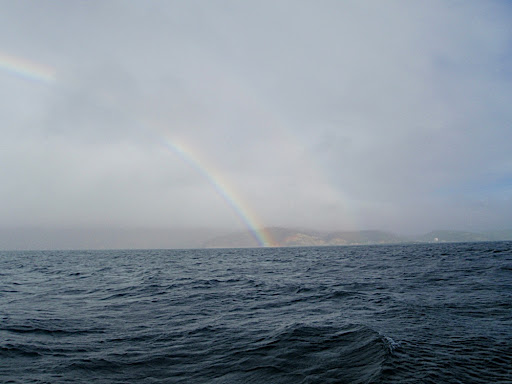 is underway a lot of things happen, the first of which is you realize you are moving. As soon as we had pulled out of the protected gulf and made our way into deeper seas, the ship began to sway, roll, tilt, and rock. This is fun at first. If you walk outside and lean over the rail (for which you get yelled at) you can see the plowing effect of the bulbous bow makes as it surges through the uneven swells of the sea, making a continuous running bow wake alongside us. If you take the time to walk the 6 flights of stairs to the top of the aft deck (a place called the sun deck, which is conveniently nestled between the two smoke stack billows) you can see the side to side rocking of the ship, with the flat tarmac of the ship crisscrossing the horizon. At other times the ship rocks and bows, with the nose digging into oncoming waves, only to rise back up again.
 On the open seas your visibility is directly related to how high above the water you are. Being only 60-90 feet up on the top deck you can only see about 26 miles in any direction, regardless of the clarity of skies. So you feel pretty isolated looking out hour after hour and seeing only blue water with the occasional white cap lacing.
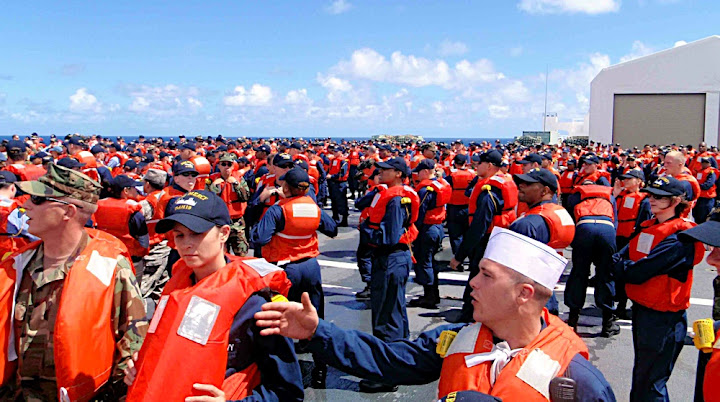
Another thing that happens is that people begin to have more time on their hands. 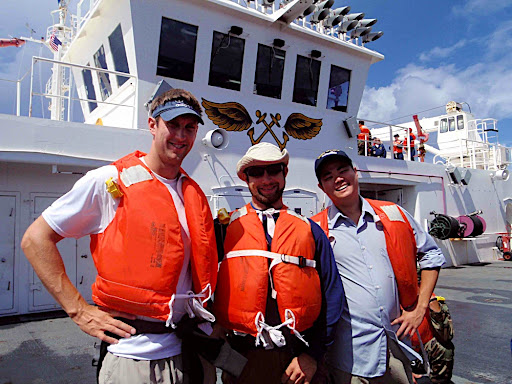 Without patients to care for other things can be done. The ship gets cleaned, items get repaired, folks get to rest, people interact with each other more, and they get to have emergency preparedness drills. These are silly drills where they “pretend” there is a fire somewhere or a man overboard or the ship is sinking. Someone gets on the intercom and sounds the alarm, then they narrate the event as if it were happening, “fire located on 01 floor aft side zone 6, it is uncontained and emergency crew personnel are arriving on the scene” or something to that extent. Meanwhile everyone has to put on a life jacket and muster (assemble) on the top deck tarmac. Each and every 1400+ people on the ship. It becomes a sea of ridiculous looking orange people. Then the alarm is called off and we go back to our normal business.
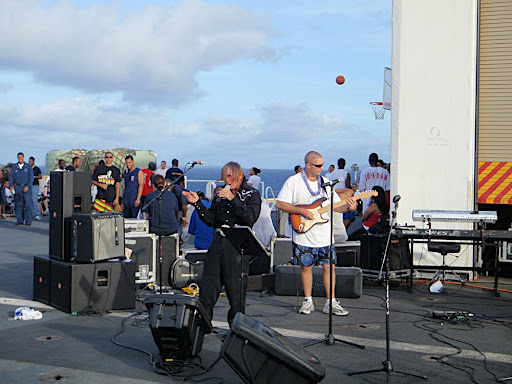
With all the time available underway the “Fun Boss” is hard at work making sure we have, well, um… fun. She throws movie nights on the top deck with a big projector displaying the movie onto the helo hanger. There are exercise classes (spin, cardio, abs, etc). Bingo nights complete with 1,500 jackpot prizes. Poker and dominoes tournaments. And something referred to as steel beach, which is essentially a beach party on the top deck all day long. 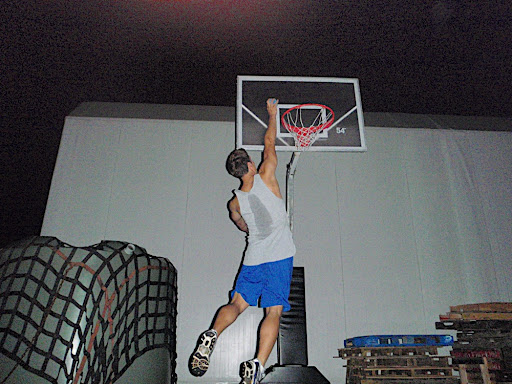 There is the Navy Band plugged into full set of amplified speakers blaring music, several inflatable kiddie pools filled with water, super soakers galore, a basketball hoop, and bbq food cooking on the grills. It’s a great time up there. I never thought I would shoot hoops on a huge Navy ship, or kick a soccer ball around, throw a Frisbee, or sit in a kiddie pool.
On the more educational side of things, we kept ourselves busy by going to CME lectures held daily, 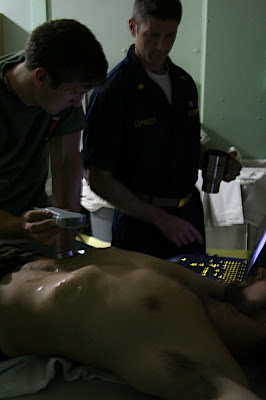 spent time with the radiologists learning how to perform ultrasound exams, and cherry-picking interesting cases from the pathologist’s collection of slides from the trip.
Of course the more days you spend at sea, the more you are ready and restless to get of the ship and see some patients.
Bon Voyage,
~Nic
Wednesday, September 10, 2008
Crossing the Line
On Wednesday at 8:30 PM 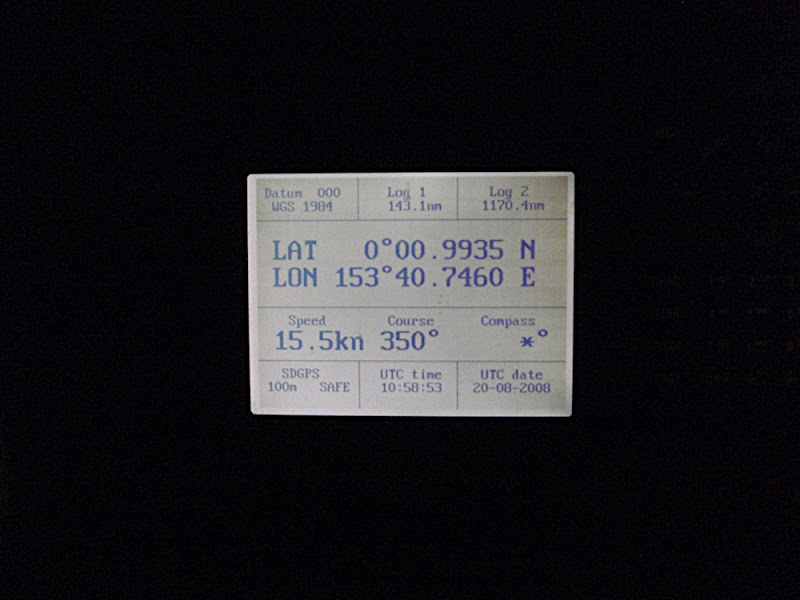 we crossed the Equator at Longitude 153.40 degrees (our latitude was, of course, 0.0 degrees). Papua New Guinea is now to lapping in our wake en route to Micronesia. We have been underway for almost 2 days now, charging into the blue ocean, crossing this imaginary line we use to segregate the poles of the earth.
There is an old Navy tradition of sorts that goes along with onboard equator crossings. Essentially there are 2 kinds of people, those that have crossed the equator on a ship (they are called shell backs, and those that have not—these are called pollywogs).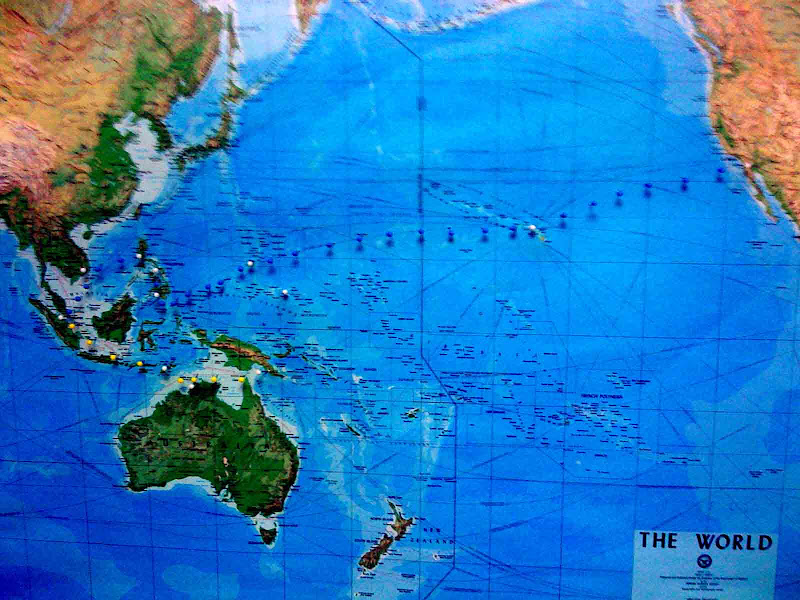 Somehow the (its not as scientific as you might think—in 5th grade science we learn a pollywog turns into a frog, not into a turtle).
Nonetheless, once you have successfully been hazed and cross the equator you care dubbed a shellback—someone who is tough, tried, and true, knows the ways of the sea, and is a true sailor. A pollywog, on the other hand is a slimy, limey, slithery nothing, who is too afraid to leave the shallows of the mucky-muck pond.
On your virgin voyage across the equator on a ship you are eligible to join the ranks of the shellbacks. But it comes with a price. The hazing involves sitting all the pollywogs together in the m idle of the deck wearing ridiculous clothing, tying you up with ropes, making you eat strange kitchen remnants, slither around while hosed down with water, and belittling you while you are expected to answer tough maritime and nautical questions. Passing this arduous pollywog flogging you get your shell.
Fortunately today they didn’t do the hazing bit (this was reserved for the FIRST time they crew passed the equator) so I guess we earned our shellbacks the easy way—or maybe we are still pollywogs? Anyway, we didn't get one of the 11x15 poster sized certificates.
As an interesting aside, once we pass the International Date Line (180th meridian) on a ship, we get inducted into the Order of the Golden Dragon. Whoo whoooo! That's definitely going in my resume!
Bon Voyage,
~Nic
 we crossed the Equator at Longitude 153.40 degrees (our latitude was, of course, 0.0 degrees). Papua New Guinea is now to lapping in our wake en route to Micronesia. We have been underway for almost 2 days now, charging into the blue ocean, crossing this imaginary line we use to segregate the poles of the earth.
There is an old Navy tradition of sorts that goes along with onboard equator crossings. Essentially there are 2 kinds of people, those that have crossed the equator on a ship (they are called shell backs, and those that have not—these are called pollywogs).
 Somehow the (its not as scientific as you might think—in 5th grade science we learn a pollywog turns into a frog, not into a turtle).
Nonetheless, once you have successfully been hazed and cross the equator you care dubbed a shellback—someone who is tough, tried, and true, knows the ways of the sea, and is a true sailor.
 A pollywog, on the other hand is a slimy, limey, slithery nothing, who is too afraid to leave the shallows of the mucky-muck pond.
On your virgin voyage across the equator on a ship you are eligible to join the ranks of the shellbacks. But it comes with a price. The hazing involves sitting all the pollywogs together in the m idle of the deck wearing ridiculous clothing, tying you up with ropes, making you eat strange kitchen remnants,
 slither around while hosed down with water, and belittling you while you are expected to answer tough maritime and nautical questions. Passing this arduous pollywog flogging you get your shell.
Fortunately today they didn’t do the hazing bit (this was reserved for the FIRST time they crew passed the equator) so I guess we earned our shellbacks the easy way—or maybe we are still pollywogs? Anyway, we didn't get one of the 11x15 poster sized certificates.
As an interesting aside,
 once we pass the International Date Line (180th meridian) on a ship, we get inducted into the Order of the Golden Dragon. Whoo whoooo! That's definitely going in my resume!
Bon Voyage,
~Nic
Monday, September 8, 2008
On Lingo
Navy / USNS Mercy vocabulary, according to Ryan
MEDCAP - Medical Civilian Action Plan. This is the name of the daily trips we take to various islands and things, for the specific purpose of helping people and/or s
aving lives. Transportation can take various forms, but usually involves a boats and buses. Services we provided include Primary Care, Pediatrics, Pharmacy, Dental (DENCAPS), Optometry, Physical Therapy, Women's Health. Typical
ly we would see something like Other "CAPS" included SURGCAPS (self-explanatory) and ENCAPS (when engineers would fix/build schools and hospitals).
p.s. I suggested to Nic that we should have a "lives saved" counter on the blog. I was not taken seriously.
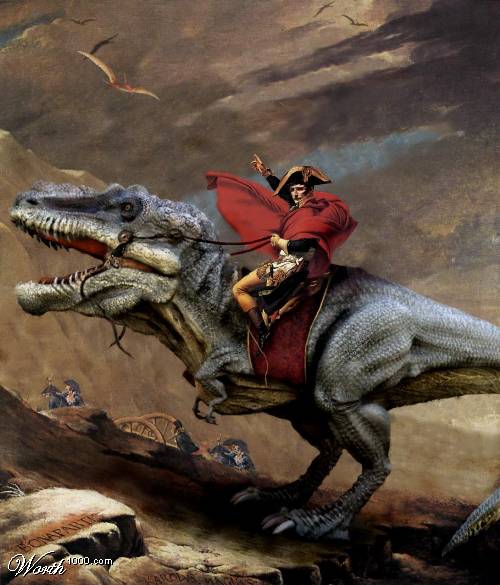
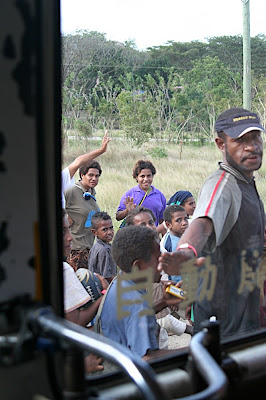
(On left, a view from inside the transport a.k.a. the bus. On right, a NapoleonCAP)

VETCAP - Veterinary Civilian Action Plan. When our awesome veterinary team would go out to help our animal friends. Usually dogs and cats, but a lot of other interesting things. Wallabees, alligators, cuscus, pigs, birds, etc. Wallabees, cuscus, and pigs were eaten when they are grown.
(Right: Cuscus)
Mess deck - Where you eat. We would get three squares a day, every day, when we were on the ship. Breakfast is 6-730, Lunch 11-1245, Dinner 430-530. Miss one of the meals, you would go hungry, no exceptions.
We all volunteered for helping out serving food. These guys work hard, and the heat in the kitchen was worse than the heat outside. And that's saying something.
Prevmed - Preventive medicine. I think this is the most important part of these missions. They would go out and survey the water supply, sanitation, etc. They would make tours through the slaughterhouses and beer factories and make recommendation. They killed the disease-carrying mosquitos.
OIC - Officer in Charge. During a MEDCAP, this guy was in charge.
MA - Master at arms. The guys with the guns. They were in charge when things get out of hand during a MEDCAP. They usually sent out three-four guys per team.
Muster - Where you meet every morning. Muster would be at 5 or 530 for a MEDCAP. Muster would be at 730 regularly. We'd often be late for muster, in which case we were forced to read the "Plan of the day" and "Menu for the day."
Colonel Muster - Where you meet in the dining room with the candlestick. (Running joke).
Flight quarters - When I would get yelled at for being outside. Apparently being around a spun-up helicopter is not the safest thing to do. Who knew?
-ryan
Wednesday, September 3, 2008
My New Haircut
I went to the barber shop today. I was getting a bit hirsute in the facial department and my hair was out of control to the point where I had to buy a jug of hair gel to keep it under wraps.  So you could say I was overdue for a trim. I walked in, sat in the nearest barber chair and the guy turns to me, “okay boss, what would you like?” “Just a little off the top to tame it down a bit, and the sides can be trimmed quite a bit,” I replied. He turned to get his equipment ready and I strained to get my head in the line of sight with the mirror across the room that didn’t quite line up with the chair. He started with the sides; hair was falling onto my shoulders and sliding down the drape with each stroke of the shaving shears. I strain a bit more to see the mirror—it looked great. He started making his way up to the top of my head, “hey boss, you want me to even this out for you?” He asked. I replied in the affirmative, while thinking to myself, “well, of course, I’m not really looking for a lopsided or asymmetric haircut here.” That must have been code for something that was lost in military to civilian translation because the next thing I knew he took a swift and broad stroke with the clippers in the mid-sagital plane. I couldn’t object… it was too late.
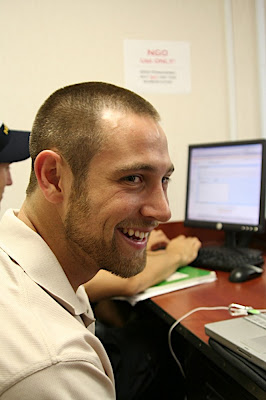 A negative mohawk was created in one fell swoop. He must have sensed my terror, “is that okay, boss?” “Yeah, sure. That’s even alright,” was all I could say. He continued to mow down the rows of long hair remaining, and in doing so he rotated my chair about its axis about 90 degrees.
At this vantage point I was staring directly at a sign no further than 3 feet away that had in big block letters “MILITARY HAIRCUTS ONLY.” I couldn’t help but laugh.
In the end it didn’t look bad at all, I mean he did a good job and all. I was just taken off guard a bit. Anyway the haircut was free, like most services on the ship… I guess you get what you pay for.
Bon Voyage,
~Nic
 So you could say I was overdue for a trim. I walked in, sat in the nearest barber chair and the guy turns to me, “okay boss, what would you like?” “Just a little off the top to tame it down a bit, and the sides can be trimmed quite a bit,” I replied. He turned to get his equipment ready and I strained to get my head in the line of sight with the mirror across the room that didn’t quite line up with the chair. He started with the sides; hair was falling onto my shoulders and sliding down the drape with each stroke of the shaving shears. I strain a bit more to see the mirror—it looked great. He started making his way up to the top of my head, “hey boss, you want me to even this out for you?” He asked. I replied in the affirmative, while thinking to myself, “well, of course, I’m not really looking for a lopsided or asymmetric haircut here.” That must have been code for something that was lost in military to civilian translation because the next thing I knew he took a swift and broad stroke with the clippers in the mid-sagital plane. I couldn’t object… it was too late.
 A negative mohawk was created in one fell swoop. He must have sensed my terror, “is that okay, boss?” “Yeah, sure. That’s even alright,” was all I could say. He continued to mow down the rows of long hair remaining, and in doing so he rotated my chair about its axis about 90 degrees.
At this vantage point I was staring directly at a sign no further than 3 feet away that had in big block letters “MILITARY HAIRCUTS ONLY.” I couldn’t help but laugh.
In the end it didn’t look bad at all, I mean he did a good job and all. I was just taken off guard a bit. Anyway the haircut was free, like most services on the ship… I guess you get what you pay for.
Bon Voyage,
~Nic
Photos Uploaded... finally!
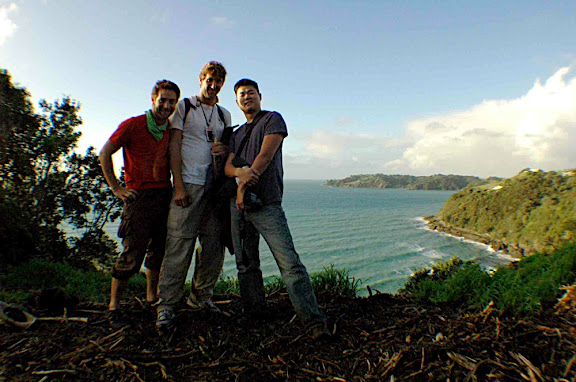
Finally, we were able to get enough bandwidth (0ff the ship) to upload our pictures thus far. Have at em! They are quite phenomenal. We will try and upload our pending posts as well to get you all up to speed. As an update, things are still going great, and we still cant think of a better way to spend 2 months... I mean is this real? We are getting elective credit for this, and hitching a ride on a boat around the south pacific. Epic is a word that simply falls short in describing this trip.
Tuesday, September 2, 2008
Gaire farewell
 Again I’ll skip the medical stuff and talk instead about how the citizens of Gaire sent us off in style. We finished relatively early that day, around 3pm. As the final patients were ushered from the pharmacy and out the gates, we were treated to a dance performance in the street by a troop of local adolescent males. I don’t really know how to describe this scene except to say that the music consisted of a whistle and rhythmic grunting and it had some obvious sexual overtones. I was unable to get an explanation from anyone about the significance of the dance, so I’ll have to let the photo speak for itself.
 Then we got a speech from the mayor and the local health department official, both praising
 the Mercy and its efforts. Next our commanding officer spoke, returning the gratitude and thanks. And once again our group was invited into the pastor’s home for refreshments. We were greeted on his porch by a crowd of women, a table piled with gifts, two trays of potato chips, and some ice-cold colas.
 As we boarded the buses one last time, the mood in the village was more excited than ever. The local police cleared the residents out of the streets to make room for our vehicles. Excited adults ran up to the buses exchanging last minute words with mercy crewmembers whom they had worked alongside for the past several days. Email addresses and phone numbers were hurriedly scribbled on scraps of paper and passed through the open bus windows. People were singing. Children ran after the buses as we pulled away. People along the road waved excitedly all the way back to the port.
--pete
Inspiration from the Little Ones
Pediatric patients are the kind that can in one single instance of brilliance and simplicity brighten your day. Their naivety, sincerity and curiosity can turn any situation into a smile. They will play with you even though they don’t know your language or customs. The following are stories of the little ones:
“Mr T” was one that made you smile without him even doing anything— I mean how can you not when you are looking at a papua new guinea kid replica of Mr. T?. His mother came to the ship for surgery and while recovering he found it fit to wheel her around the ward, a feat that he was not that good at, yet he persisted. At the helm of the wheelchair “Mr. T” scooted his mom into many a table, bed, or pillar before she finally brought him under wraps. Mom said that she finally caved in and gave him this haircut because Mr. T is his hero.
The twins (in green) and their little sister (in red—that’s not ptosis you’re seeing) are a feisty lot. Their dad is a big burly guy who runs the boxing club in Port Moresby. They came to me for a physical examination to “see if it was okay for them to box.” These girls were in great health, and at the end of the exam I decided to have one final test. They each wound up and were told to take a hard swing at my shoulder the way their dad taught them to do. After the second punch I was nearly knocked off my flimsy plastic chair.
I was walking down CasRec when I saw this little girl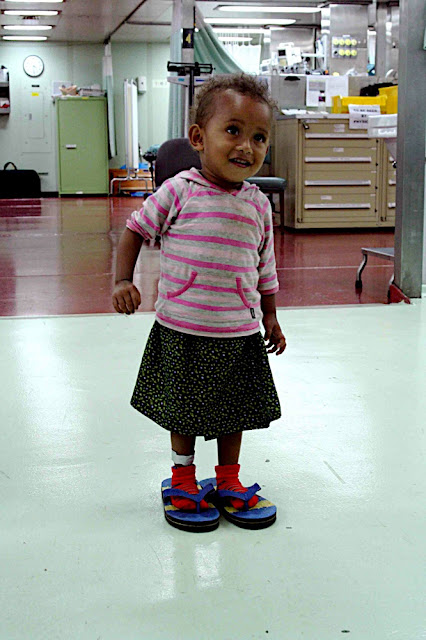 scooting around in circles, shuffling her feet and cooing with excitement. She had commandeered her mom’s sandals and was parading on the newly waxed floor. You can’t help but stop and watch her regal procession. Soon there was a crowd of 4 or 5 of us. The picture doesn’t capture it all, but sufficed to say she is a cute one.
Sometimes the kids don’t come with smiles and excitement. Sometimes they are scared, apprehensive, guarded, and crying. You learn very quickly that the child is in control of the visit and will only let you do what they are comfortable with. Your job is to earn their trust and confidence. This is one of my favorite challenges in pediatrics. The first thing you have to do is establish trust and an amiable relationship with the parent. Ignore the crying child, and focus on the parent first. Children are smart and very observant, even when they are crying. Establishing rapport with the parents, talking with them, shaking their hands, examining them, all tell the child that you are a safe “stranger” that mom and dad are okay with. Next you address that child. Tricks of diverted attention, systematic desensitization, magical wizardry, and of course bribery are employed at this point. For example, I always show them my stethoscope and have them hold it to show them it is not dangerous. If they are old enough I ask them to put it on their heart. I’ll show them what I’m going to do first on mom so that they see its safe. I’ll give them things to hold and inspect while I hold and inspect them. I’ll show them my pen-light and shine it through the nail of my pinky finger, turning the tip an orange-pink, making an ET effect. If this fails, there isn’t a kid around that doesn’t finally crumble their outer shell to accept a nitrile-glove-balloon-man gift.
Bon Voyage,
~Nic
“Mr T” was one that made you smile without him even doing anything—
 I mean how can you not when you are looking at a papua new guinea kid replica of Mr. T?. His mother came to the ship for surgery and while recovering he found it fit to wheel her around the ward, a feat that he was not that good at, yet he persisted. At the helm of the wheelchair “Mr. T” scooted his mom into many a table, bed, or pillar before she finally brought him under wraps. Mom said that she finally caved in and gave him this haircut because Mr. T is his hero.
The twins (in green) and their little sister (in red—that’s not ptosis you’re seeing) are a feisty lot.
 Their dad is a big burly guy who runs the boxing club in Port Moresby. They came to me for a physical examination to “see if it was okay for them to box.” These girls were in great health, and at the end of the exam I decided to have one final test. They each wound up and were told to take a hard swing at my shoulder the way their dad taught them to do. After the second punch I was nearly knocked off my flimsy plastic chair.
I was walking down CasRec when I saw this little girl
 scooting around in circles, shuffling her feet and cooing with excitement. She had commandeered her mom’s sandals and was parading on the newly waxed floor. You can’t help but stop and watch her regal procession. Soon there was a crowd of 4 or 5 of us. The picture doesn’t capture it all, but sufficed to say she is a cute one.
Sometimes the kids don’t come with smiles and excitement. Sometimes they are scared, apprehensive, guarded, and crying. You learn very quickly that the child is in control of the visit and will only let you do what they are comfortable with. Your job is to earn their trust and confidence. This is one of my favorite challenges in pediatrics. The first thing you have to do is establish trust and an amiable relationship with the parent. Ignore the crying child, and focus on the parent first. Children are smart and very observant, even when they are crying. Establishing rapport with the parents, talking with them, shaking their hands, examining them, all tell the child that you are a safe “stranger” that mom and dad are okay with. Next you address that child.
 Tricks of diverted attention, systematic desensitization, magical wizardry, and of course bribery are employed at this point. For example, I always show them my stethoscope and have them hold it to show them it is not dangerous. If they are old enough I ask them to put it on their heart. I’ll show them what I’m going to do first on mom so that they see its safe. I’ll give them things to hold and inspect while I hold and inspect them. I’ll show them my pen-light and shine it through the nail of my pinky finger, turning the tip an orange-pink, making an ET effect. If this fails, there isn’t a kid around that doesn’t finally crumble their outer shell to accept a nitrile-glove-balloon-man gift.
Bon Voyage,
~Nic
Subscribe to:
Posts (Atom)

